
The Titan’s Heart – Chapter 3
Sonja
The pack is a personal attack. Lukas had called it mine, but it feels like an instrument of torture designed by a sadist with an advanced degree in gravitational physics. It must weigh a literal ton. My own pack, the one I’d spent weeks obsessively configuring for optimal weight distribution and accessibility, sits abandoned back in his shop, a monument to my hubris. My shoulders scream in protest with every step, and the stiff, unforgiving leather of my new boots is already rubbing my heels raw. This isn’t an expedition; it’s a forced march.
And Lukas. He moves like a machine. His own pack looks even larger than mine, a veritable mountain of canvas and straps, yet he glides over the rough terrain with an easy, ground-eating stride that seems to mock my every pained step. He doesn’t sweat. He doesn’t breathe heavily. He’s a walking, talking, infuriating affront to the laws of human biology.
“Do you ever get tired?” I ask, the words coming out as a gasp as I haul myself over a series of steplike volcanic rocks. My lungs are sandpaper, and my chest is tight with the exertion.
He doesn’t turn around. “Sometimes.”
His single word hangs in the crisp air. A lie, for certain. He’s probably powered by some kind of geothermal battery, his ligaments made of carbon fiber.
It’s the only logical explanation.
We’ve been walking for three hours, and the initial, charming pastoral landscape of rolling green hills has given way to something more primal. The tussock grass is the color of old gold, and it ripples in the wind like a living pelt. The ground beneath my feet is a mix of hard-packed earth and sharp, porous volcanic scree that shifts unpredictably. The trail itself is less a path and more a vague suggestion. We’re heading toward the jagged, snow-dusted peak of Tongariro, a slumbering giant against the impossibly blue sky. It’s beautiful, but it’s a harsh, unforgiving kind of beauty.
I need to stop. My scientific mission is being completely subverted by this relentless pace. I have an array of six wide-band seismic sensors to deploy, each one costing more than a used car. Their placement is critical, determined by ground-penetrating radar surveys I’d analyzed for months.
I spot the first designated location ahead: a relatively flat shelf of exposed bedrock, perfectly situated to capture the deep, low-frequency tremors from the magma chamber below.
“I need to stop here,” I say, my voice firm. “This is a sensor site.”
Lukas stops, and the sudden halt is so jarring I nearly stumble into him. He turns slowly, his expression unreadable. “No.”
“No? What do you mean, no? This is the entire point of the expedition. I place sensors. You get paid an obscene amount of money. That was the deal.”
“The deal was I get you back down in one piece,” he says, his voice a low, flat rumble. He points a finger toward a gathering of clouds massing on the western horizon. They look innocuous to me, like fluffy cotton balls. “That’s a front moving in. The wind will pick up in an hour. It will bring rain. Cold rain. We need to be over that next ridge and into the sheltered valley before it hits. Setting up a sensor takes time.”
“It takes twenty minutes,” I argue, shrugging off the oppressive weight of the pack. It lands on the ground with a heavy thud. The relief to my shoulders is immediate and glorious. “I’ve timed it. I can have it calibrated and recording while you — I don’t know — chop some wood with your teeth or whatever it is you do.”
The corner of his mouth twitches. Infuriating. “Twenty minutes here is thirty minutes we lose on the ascent. That puts us at the campsite after dark. We don’t travel after dark.”
“It’s barely noon! We have hours of daylight.” I gesture at the sky. “And those are just cumulus humilis clouds. Common fair-weather indicators.”
He gives me a look that is so full of pity it makes my blood boil. “On the coast, maybe. Up here, where the cold air from the west hits the thermal updrafts from the volcanic field… they build. Fast. They become something else.” He looks past me, his gray eyes scanning the landscape with an analytical intensity that rivals my own. It’s not instinct, I remind myself. It’s high-level pattern recognition. He’s just been here longer. “That valley is our only viable shelter for the next ten kilometers. We’ll be exposed on the ridge when the front hits if we stop now. It’s not a risk I’m willing to take.”
His logic is sound. Annoyingly sound. The responsible part of my brain, the part that writes risk assessments and adheres to safety protocols, knows he’s right. But the scientist in me, the part that has staked her entire career on this trip, screams in frustration.
“Fine,” I snap, my voice tight with defeat. I bend to heave the pack back on, the movement sending a fresh stab of pain through my raw heels. “But tomorrow, I’m placing a sensor. Even if it means you have to miss your afternoon bear-wrestling session.”
He doesn’t reply. He just turns and starts walking again, his silence a more effective rebuke than any argument. I grit my teeth and follow, my fury a hot, bright flame in my chest. I’m a client paying for a service, not a child on a school trip.
But out here, the rules are different. The power dynamic has shifted completely. My credentials, my intelligence, my carefully laid plans? They mean nothing against the stark, physical reality of the mountain and the man who seems to be an extension of it.
We walk for another hour in silence. The clouds on the horizon are no longer fluffy cotton balls. They’ve merged and darkened, their underbellies turning an ominous purple. The wind picks up, whistling a low, mournful tune through the tussocks.
He was right.
The knowledge settles in my stomach like a cold stone.
Just as the first icy drops of rain begin to fall, we descend into the promised valley. It’s a shallow basin carved between two ridges, offering a small reprieve from the now-howling wind.
Lukas finds a spot beneath a rocky overhang, and we set up a spartan camp with an efficiency that is entirely one-sided. He moves with a fluid, practiced economy, while I’m clumsy and slow, my fingers stiff with cold as I struggle with the unfamiliar buckles on my pack.
The rest of the afternoon is a miserable, damp affair. The rain becomes a steady, driving downpour. I sit huddled in my waterproof gear, watching Lukas methodically check our equipment. There’s a stillness about him, a deep-seated calm in the face of the storm that I find both unsettling and, if I’m being honest, a little enviable. My mind is always racing, analyzing, hypothesizing.
His seems to just… be.
I settle into my sleeping bag, close my eyes, and drop off to sleep before he can tell me to do anything else.
The next day dawns cold but clear. The rain has washed the air, and every color seems brighter, every edge sharper. The good news is, my heels are no longer just rubbed raw; they’ve graduated to full-fledged, liquid-filled blisters. Walking is exquisite agony.
“You need to lance those,” Lukas says, his gaze fixed on my feet as I try to subtly limp my way through breakfast.
“I’m fine,” I lie.
He sighs, a sound of profound patience being tested. He rummages in his pack and produces a small, sterile medical kit. He pulls out a needle and holds it in the flame of his camp stove. “Take off your boot, Sonja.”
It’s a command, not a request. The way he says my name, a low, gravelly sound, irritates the hell out of me. Defeated, I peel off my sock and wince as the fabric sticks to my heel. The blister is a nasty, swollen monstrosity.
He kneels in front of me, and his proximity is overwhelming. He’s a monolith of contained force, heated, charged, ready to pounce. He takes my foot in his hand. His palm is rough and calloused, but his touch is surprisingly gentle. My breath catches in my throat. This is a level of physical contact I am completely unprepared for.
With a quick, practiced motion, he lances the blister. I flinch, but the relief is immediate. He carefully dresses the wound with a piece of moleskin from his kit.
“The boots are stiff,” he says, his head still bent over his work. “It’s the only way to get the support you need on this terrain. It’ll get better.”
“Thank you,” I whisper.
He glances up, and his gray eyes meet mine. For a fraction of a second, the professional mask slips, and something else lurks in their depths — something dark and ancient.
Then it’s gone.
He gives a short, sharp nod, releases my foot, and stands up. The moment is over.
“We need to make up for lost time,” he says, his voice back to its usual gruff tone. “Pack up.”
My foot feels better, but my pride is a fresh wound. I need him. I hate that I need him.
The clash I’d been expecting finally comes a few hours later. We reach the bank of a river that isn’t on my map. Or rather, my map shows a thin blue line, a creek, but the reality is a churning, thirty-foot-wide torrent of milky, gray-brown water. It roars as it funnels through a narrow gorge, carrying small branches and other debris in its angry current.
“Glacial outburst flood,” I state, my inner geologist taking over. “Or a geothermal pocket breached. The high turbidity suggests significant sediment load. Velocity appears to be around two meters per second at the center channel.”
Lukas gives me a look. “It’s a swollen river, Doc. And we need to get across it.”
“We can’t cross that,” I say, a knot of fear tightening in my stomach. “The current is too strong. We should find a place to wait for it to recede.”
“Could take days,” he says, already shrugging off his pack. “And upstream is a canyon. Downstream, it widens into a marsh. This is the only viable crossing point for kilometers. We cross here.”
He pulls the vibrant orange rope from his pack. “I’ll go first and secure a line. I’ll get you across.”
His confidence is absolute. It’s terrifying. “Are you insane? You’ll be swept away.”
“No, I won’t,” he says, and the simple finality of it silences me. He ties one end of the rope around his waist and hands me the other. “Just brace yourself. Don’t let it pull you in.”
Before I can protest further, he wades into the torrent. The water immediately surges past his knees, then his thighs. Any other person would be fighting for balance, struggling against the immense, crushing force. Lukas just plants his feet and walks. He moves slowly, deliberately, a boulder resisting a flood. What the hell? The sheer, raw power required to do what he’s doing is staggering. He reaches the other side, scrambles up the bank, and expertly secures the rope to a thick, gnarled tree trunk. Then he turns and gestures for me to come.
My heart is pounding against my ribs, a frantic drumbeat against the roar of the water. No, no I do not want to go.
Don’t go, Sonja. Turn around and go back to the States and forget this damnable mission.
I don’t listen. I take a deep breath and try to channel my fear into analytical focus. This is a physics problem. Force, mass, and vector. I can do this.
I grip the rope with both hands and step into the river.
The cold is like a brick to the face. It sucks the air from my lungs and drives a thousand icy needles into my skin. The force of the current is a solid, battering wall, far stronger than I’d calculated. It tries to tear my feet from under me, to rip the rope from my hands. I move sideways, shuffling my feet along the slick, unseen rocks of the riverbed, my knuckles white where I cling to the rope.
I’m halfway across. The water is deeper here, up to my waist, and its pull is relentless. I concentrate on my footing, on the next small step. I place my boot on what looks like a flat, stable rock.
It’s a mistake.
The stiff, unfeeling sole of my new boot can’t register the thin layer of slick, green algae coating the stone. My foot shoots out from under me. The world tilts. One moment I’m vertical, fighting; the next I’m horizontal, consumed.
The roaring of the water fills my head as I go under. The cold is absolute. It’s a crushing, suffocating weight. Panic, pure and primal, explodes in my chest. My hand loses its grip on the rope. I’m-tossed and spun in the gray, churning chaos, my limbs flailing uselessly.
This is it. This is how it ends. Drowned in a nameless river in the middle of nowhere. A stupid, avoidable accident.
Something clamps around my bicep like a band of steel. It’s not a grab; it’s an arrest. My body, which was being swept downstream, stops so abruptly that the force of it knocks the last of the air from my lungs. I surface, sputtering and gasping, my head breaking into the roaring air.
Lukas is there. He’s in the river with me, somehow. He wasn’t there a second ago. He was on the bank. But now he stands planted in the deepest, fastest part of the channel as if he were part of the bedrock itself, the churning water breaking around him. He hauls me against his side, his arm a solid bar across my chest. I’m plastered to his body, my cheek pressed against the hard muscle of his chest, and the incredible, solid heat of him warms me even through the freezing water.
The sheer, impossible strength is baffling. He’s an anchor in the maelstrom. A force of nature holding back another. He doesn’t say a word. He just moves, half-carrying, half-dragging my dead weight towards the far bank. He deposits me on a patch of grass like I weigh nothing.
I collapse onto my hands and knees, coughing up water, shivering so violently my teeth ache. Every muscle in my body is screaming, locked in a spasm of cold and adrenaline. He steps away, and my first coherent thought is an absurd pang of loss at the removal of his warmth.
“Get the wet layers off. Now.” His voice is a harsh growl, cutting through the fog of shock.
He’s already stripping off my soaked outer jacket and fleece with rough, impersonal efficiency. I’m too shaken, too cold to protest. Embarrassment? I have none. He pulls a dry thermal shirt from the depths of his own pack (how is anything in there dry?) and shoves it at me. “Put this on.”
My fingers are numb and useless. I fumble with the wet clothes I’m still wearing. He lets out an impatient sound and helps me, his large, rough hands surprisingly deft as he peels my soaked shirt away and helps pull the dry one over my head.
I finally manage to look at him properly. He’s soaked, his dark hair plastered to his forehead, his henley clinging to the powerful contours of his chest and arms. But he’s not shivering. He’s not even breathing hard. He’s just watching me, his jaw tight, his stormy eyes burning with a fierce light. Anger. He’s angry with me.
My mind, my logical, scientific mind, scrambles to find an explanation. The speed. The strength. The way he stood in that current. It’s not possible. Adrenaline can account for a lot, but not that. It defies physics. It defies biology. It defies everything I know to be true.
Maybe he’s part robot? A genetic anomaly? I don’t know.
“Are you okay?” he asks, his voice still gruff, but the edge is gone. He’s asking if I’m hurt, if I’m in shock. But his eyes are… “intense” is the only word.
I sit on the riverbank, wrapped in his dry shirt that smells of him — of leather and woodsmoke and the wild. I’m shaking, soaked, and utterly humiliated.
I’m also alive. I’m alive because of him. Impossibly alive.
I look at him, at the quiet ferocity in his gaze, and I realize with a certainty that chills me more than the river ever could, that the mountain isn’t the most dangerous thing out here.
He is.
You have been reading The Titan's Heart...
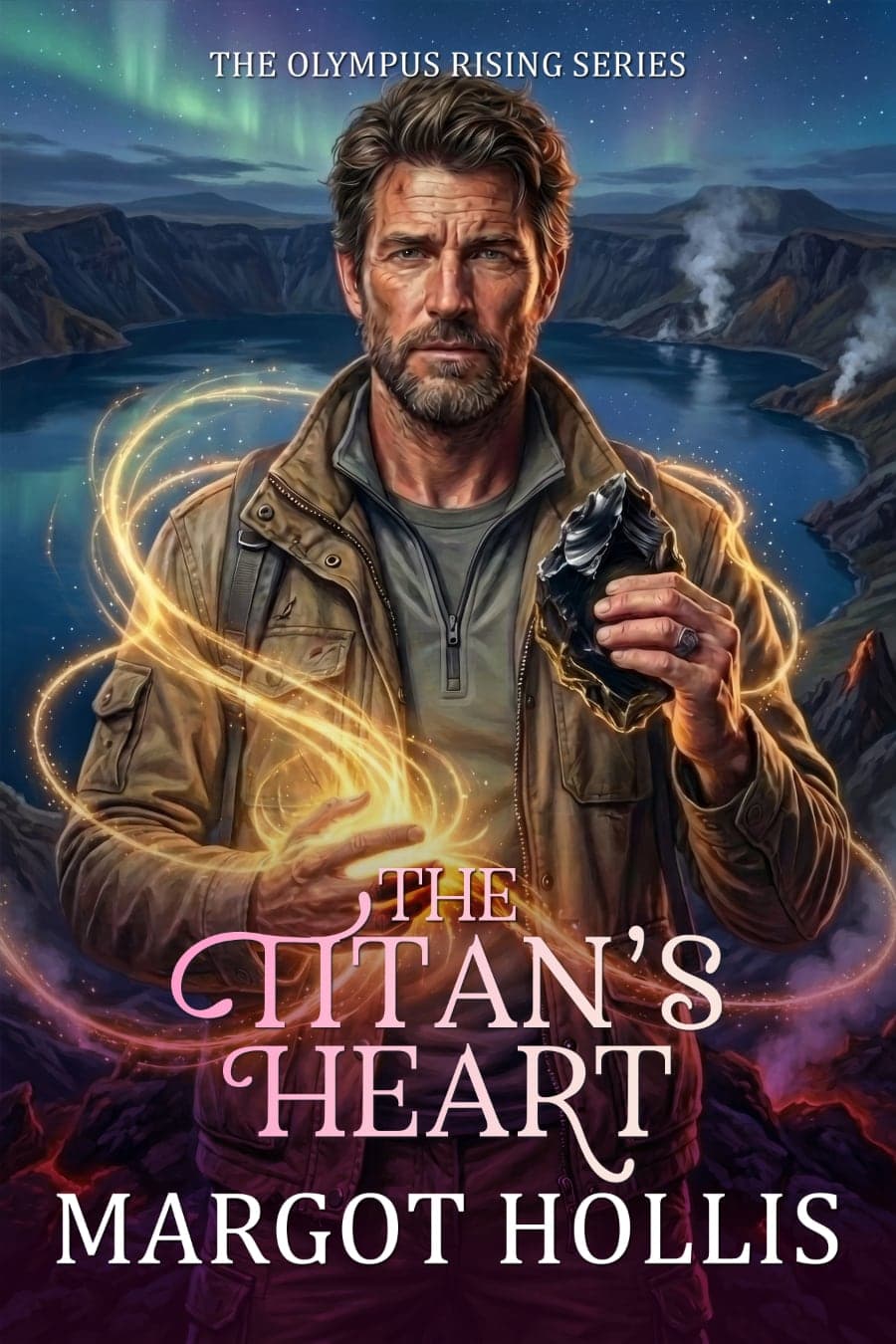
My grumpy New Zealand guide just turned out to be the God of War. And he’s been lying to me since the moment I hired him.
Lukas Helms treated my PhD like fancy paperwork and my equipment like expensive junk. Every word from him was clipped, dismissive, professional. I told myself I didn’t care. I told myself the way he looked at me—like I was something fragile he desperately wanted to protect—meant nothing.
Then my Resonance Imager detected a heartbeat beneath the volcano.
A portal tore the sky open. Gods walked through. And Lukas, who’d been hiding in these mountains for 150 years, was forced to reveal exactly what he is.
Now his sons are hunting us. Cultists are closing in. And the weapon I accidentally woke—the Titan’s Heart—is calling every power-hungry monster in the mythological world to our doorstep.
Lukas swears he’ll protect me. But if his enemies reach us first, protecting me might mean becoming the very thing he’s spent centuries trying to bury.
