
The Titan’s Heart – Chapter 4
Lukas
The power recedes. It’s a physical sensation, like a fever breaking. A tide of white-hot energy withdrawing from my limbs, leaving behind a tremor in my muscles and a cold film of sweat on my skin. It had surged without my permission, a reflex as old as my name, when I saw her slip beneath the churning gray water. The beast roared, just for a second. An ancient, possessive fury. Mine to protect.
I smother it. I shove it back into the cage of discipline and mortal routine where it belongs. The effort leaves me hollowed out, my hands clenched into fists at my sides to stop their shaking.
The fight for control is always the hardest war.
Sonja collapses on the bank, a heap of wet wool and shock. She coughs, her body racked with violent shivers. She’s alive. That’s the only data point that matters. The objective is intact. But the cost was too high. I almost let it out.
“Get the wet layers off. Now.” My voice is a rasp, harsher than I intend. It’s the only tone I can manage, a command ground out through a jaw tight enough to crack stone. It’s not for her. It’s for me. A brutal act of reasserting order.
I strip her jacket from her shoulders with rough, automatic motions. The fabric is heavy with river water. My own clothes are soaked, a cold plaster against my skin, but I feel nothing. My internal fire burns too hot for the cold to touch.
I am aware only of her. The pale skin of her arms, the frantic, panicked pulse fluttering at the base of her throat. The animal part of me, the one that answered her silent scream for help, wants to haul her against me, to wrap her in my arms and pour my own warmth into her until she stops shaking.
I hate it. The instinct is a poison.
I shove one of my own dry shirts at her. “Put this on.”
Her fingers are clumsy, blue with cold. She fumbles with the buttons of her wet shirt, her movements jerky and uncoordinated. I let out a sound of pure impatience and move to help, my own hands surprisingly steady. My calloused fingers brush against the soft skin of her ribs as I tug the wet fabric away.
The contact is electric. A jolt, a spark in the cold air that has nothing to do with static. It ignites a low, simmering heat deep in my gut.
I pull back as if burned, my control fraying at the edges.
She finally gets the dry shirt on. Huddled inside the large thermal mass of it, she looks small, fragile. A drowned bird I’ve just pulled from a torrent. Her hair is a mess, plastered to her head, and her face is pale.
But her eyes… they’re not just full of shock. They’re full of questions. Sharp, analytical eyes that are trying to process data that does not compute. She’s not looking at a guide who just performed a daring rescue, she’s looking at an anomaly. An impossibility.
“Are you okay?” The question is a deflection. A way to turn her analytical gaze away from me, back onto herself.
She doesn’t answer. She just stares, her mind clearly working, trying to reconcile the man on the bank with the man who stood in the middle of a flood like a pillar of granite. I can almost hear the gears turning. How did he get there so fast? How did he stand against that current?
I have to shut it down.
I turn away from her, breaking the intensity of her stare. I grab our packs, which I’d left on the bank before going after her. The weight is a familiar anchor, a reminder of the physical, mortal world I inhabit by choice.
“We lost time,” I say, my voice flat and devoid of emotion. “We camp here tonight. Gather firewood. Small pieces. Dry ones from underneath the overhangs.”
I don’t wait for a response. I don’t offer comfort. I don’t acknowledge what just happened. The river swept her away. I pulled her out. The end.
It was a physical transaction, a problem and a solution. Attaching any more meaning to it is a weakness I cannot afford. I need to rebuild the wall between us, and I need to do it now.
Higher. Thicker. Impenetrable.
The rest of the evening unfolds in a tense, near-complete silence. I work with brutal efficiency, my movements sharp and economical. I build a fire, the crack of snapping branches under my hands louder than necessary. The flames catch quickly, a hungry, roaring thing that I feed with a grim satisfaction.
Fire is simple. It consumes. It destroys. It gives warmth.
I understand it.
Sonja, after a period of quiet shivering, seems to regain some of her composure. She retrieves her own pack, her movements stiff and slow. I expect her to be shaken, maybe even tearful. She is neither. She opens one of the waterproof cases that holds her precious scientific equipment, her expression one of fierce, focused concentration.
I watch her from the corner of my eye as I prepare a meal. Dehydrated stew. Just add boiling water.
She lays out a series of small, metallic objects on a dry cloth, her brow furrowed as she inspects them. She handles them with a surgeon’s care, her fingers, though still pale from the cold, moving with a delicate precision that fascinates me against my will. She connects a wire and checks the readings on a small, handheld monitor. She is completely absorbed, her entire world narrowed to the task at hand. She’s not cowering. She’s not complaining. She’s working.
Her resilience is exasperating.
I had expected the river to break her. To send her running back to the safety of her labs and lecture halls. I had hoped it would because that would have solved my problem. Instead, she sits by my fire, in my dry clothes, meticulously tending to her own strange gods of data and electricity.
She’s tougher than I gave her credit for. Another miscalculation on my part.
I hand her a steaming mug of stew without a word. She takes it, her eyes never leaving the monitor in her other hand.
“Thank you,” she murmurs, the words almost lost in the crackle of the fire and the distant roar of the river.
I grunt in response and retreat to the other side of the fire, putting the flames between us. A physical barrier. I eat my own meal, the food tasteless ash in my mouth. The silence stretches, thick and heavy. A thousand things hang in the space between us, unspoken. The impossibility of my strength. The terror of her near-death. The raw, unsettling intimacy of the rescue. I can feel the questions massing behind her lips, and I deflect them with a wall of stoic disinterest.
If she asks, I will lie. Adrenaline. Lucky footing. Nothing more. But she doesn’t ask.
She keeps working.
The sun sets, painting the underside of the clouds in violent strokes of orange and purple. The temperature plummets. The world outside our small circle of firelight becomes a vast, dark wilderness. It’s a landscape that has always brought me a measure of peace. Its indifference is a comfort. The mountain does not judge. It simply is.
Tonight, though, the peace doesn’t come. I’m caged. Watched. Not by her, but by myself. The beast is awake now, pacing the confines of its prison, testing the bars. It savored that brief moment of release in the river, and it wants more.
Sonja finally packs her equipment away. She pulls her sleeping bag from her pack and lays it out as far from me as the small overhang will allow.
“I’ll take the first watch,” I say. It’s not an offer.
She looks at me, and for the first time since the river, her gaze is direct. The analytical curiosity is gone, replaced by a weary sort of calculation. “I can take a watch.”
“No.”
“I’m not helpless, Lukas.”
The sound of my name from her lips… I inhale. She hasn’t used it before. Just ‘you’. The word, in her voice, has a weight. It’s not the name on the form she filled out. It feels like she’s naming me. The man who pulled her from the water. It’s too personal.
“Your job is science,” I say, my voice colder than the night air. “My job is to keep you alive. That includes letting you get a full night’s sleep so you don’t trip and fall off a cliff tomorrow. Go to sleep.”
“Why do we even need a watch?” she asks, her analytical mind refusing to shut down. “We’re not being pursued by anything. This isn’t a military operation.”
“It’s standard wilderness protocol.”
She raises an eyebrow. “In New Zealand? The most dangerous animal here is what? A particularly aggressive sheep?”
“It’s not about animals.”
“Then what? Weather? Flash floods?” She sits up straighter, her eyes narrowing. “Or is it just that you don’t want to talk to me about what happened at the river?”
The accuracy of her assessment hits too close. I keep my face impassive.
“The weather can change in minutes. Storm systems can develop without warning. Rock slides. There are a dozen potential threats that require monitoring.”
“And you’re the only one qualified to monitor them.” It’s not a question. Her tone is dry, almost amused.
“Yes.”
She studies me for a long moment, her eyes reflecting the dying firelight. I can see her cataloging my responses, filing them away with all the other data points that don’t add up.
“You know,” she says finally, “for someone whose job is communication, you’re remarkably determined not to communicate.”
“My job is to guide. Not to chat.”
A flicker of anger sparks in her eyes, but it’s quickly replaced by exhaustion. She knows it’s a fight she won’t win. She gives a tight, angry nod and retreats into her sleeping bag, zipping it up until only the top of her head is visible. Within minutes, her breathing evens out, deepening into the slow, steady rhythm of sleep.
The fire is a low bank of glowing coals now. The river is a constant, distant roar. The moon has risen, a sliver of bone-white light in a sea of stars. It’s quiet.
It’s just me and the darkness.
And her.
My body is a knot of tension. I stay seated, my back against the cold rock, my senses on high alert. I track the sound of a distant morepork, the rustle of tussock grass in the wind, the faint, earthy scent of damp soil. These are the familiar metrics of my solitude.
But tonight, they’re just background noise. My awareness is entirely focused on the small, still form on the other side of the fire.
I should be thinking about the route tomorrow. The weather. The state of our supplies. Tactical concerns. My mind, usually a clean, efficient machine of risk assessment, is a chaotic mess. It keeps replaying the moment in the river. The feel of her body plastered against mine. The dead weight of her in my arms. The terror in her eyes turning to relief.
A warrior king I once knew, long turned to dust and legend, told me that attachments were anchors. They keep a man from being swept away by the currents of war. He was a fool. Attachments are not anchors; they are chains. They bind you to something that can be threatened. Something that can be taken. They give your enemies a weapon to use against you. The only way to win is to have nothing to lose.
I have spent centuries making sure I have nothing to lose.
I get up and walk to the edge of the overhang, needing to put more distance between us. I stare out into the vast, indifferent darkness of the valley. The air is so cold it hurts to breathe, a clean, sharp pain that helps to focus the mind. I try to force my thoughts back into their usual channels.
Threat assessment.
Threat one: the environment. The mountain, the weather, the river. These are predictable dangers. Manageable.
Threat two: the client. Her inexperience. Her stubbornness. Her fragility. Also manageable, though irritatingly so.
Threat three: me. The power I keep leashed. The instincts I fight to suppress. The memories I work to bury. This is the real danger. Unpredictable. Unmanageable.
Sonja Reed, with her sharp eyes and sharper mind, is a catalyst. She is turning a dormant threat into an active one.
I betrayed myself today. I used a fraction of my true strength not out of strategic necessity, but out of pure, unthinking instinct. The instinct to protect. It felt… good.
That’s the most terrifying part.
For a single, fleeting moment, it felt right to unleash that power in the service of another. Not for conquest, not for rage, but for preservation. The feeling is a lure. A trap. It promises purpose, connection. It delivers only ruin.
I turn back and look at her.
She shifts in sleep, moonlight illuminating her softened face. The defiant scientist is gone, replaced by a vulnerable woman. Her peaceful breathing calms the storm within me.
The tension unwinds as I watch her, my internal rage quieting. Her presence evokes a long-forgotten sensation: peace. Not the peace of solitude, but of connection. A profound stillness settles into my soul, unsettling in its gentleness.
This quiet resonance is the first link in a chain that will bind me, drawing me back into the world — and inevitably, to war.
I am the God of War. Peace is not my domain. Peace is my enemy.
I look at the sleeping woman who has brought this enemy into my camp, into my carefully guarded heart. I’m no longer just her guide. I’m her guardian. And that means I am, once again, in unimaginable danger.
Not from the mountain.
But from what she makes me want to be.
You have been reading The Titan's Heart...
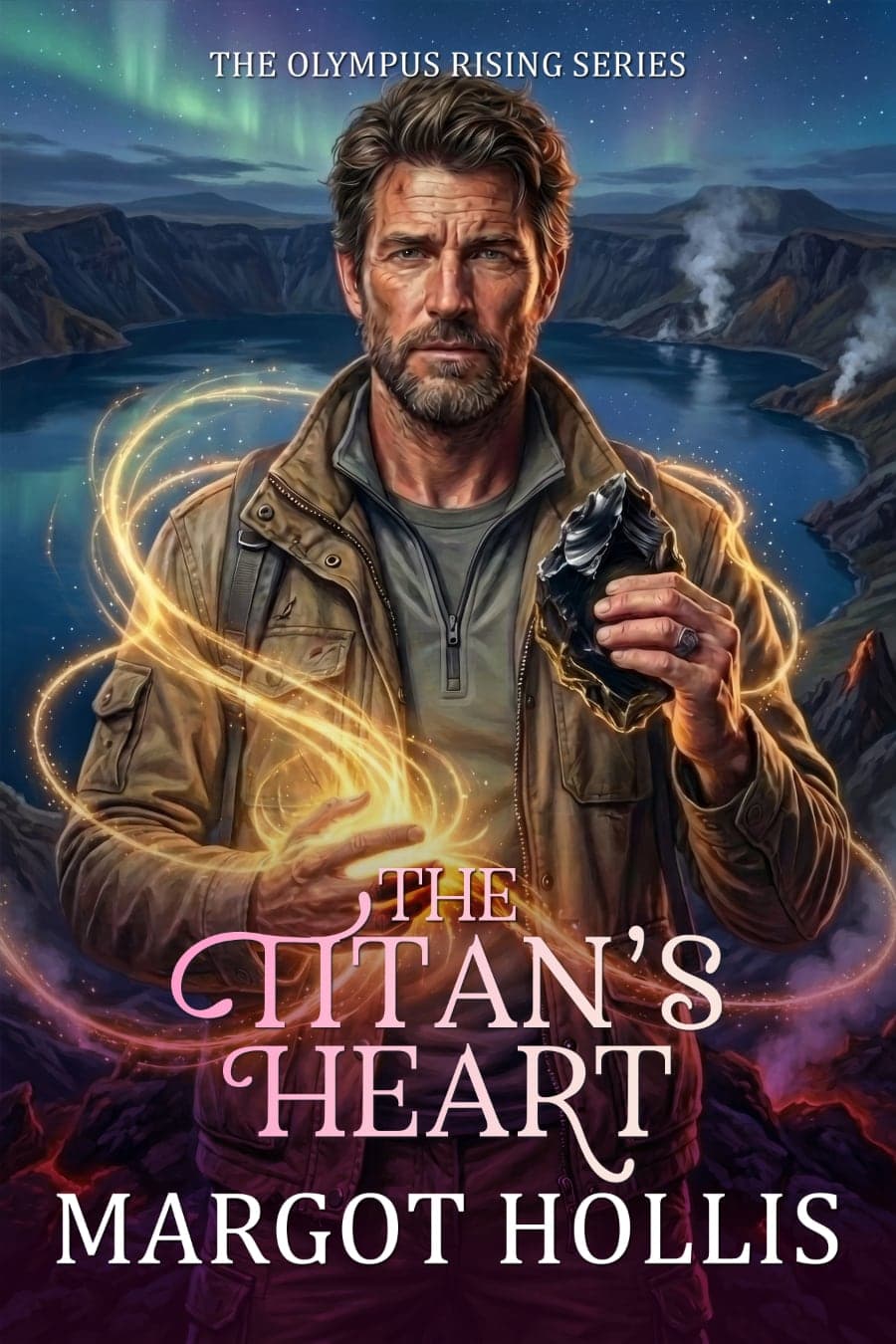
My grumpy New Zealand guide just turned out to be the God of War. And he’s been lying to me since the moment I hired him.
Lukas Helms treated my PhD like fancy paperwork and my equipment like expensive junk. Every word from him was clipped, dismissive, professional. I told myself I didn’t care. I told myself the way he looked at me—like I was something fragile he desperately wanted to protect—meant nothing.
Then my Resonance Imager detected a heartbeat beneath the volcano.
A portal tore the sky open. Gods walked through. And Lukas, who’d been hiding in these mountains for 150 years, was forced to reveal exactly what he is.
Now his sons are hunting us. Cultists are closing in. And the weapon I accidentally woke—the Titan’s Heart—is calling every power-hungry monster in the mythological world to our doorstep.
Lukas swears he’ll protect me. But if his enemies reach us first, protecting me might mean becoming the very thing he’s spent centuries trying to bury.
