
The Titan’s Heart – Chapter 2
Lukas
The little bell chimes, announcing her departure. The sound is too cheerful for the tension she leaves behind in the air, a residue of clean soap, expensive waterproof fabric, and pure, stubborn defiance. I stand motionless behind the desk until I hear her footsteps fade completely down the street.
Silence returns.
My silence. The peace I have cultivated for years in this quiet corner of the world. It feels different now. Thinner.
I run a cloth over the polished surface of the desk, wiping away the spot where her hands rested, where her map lay. The action is methodical, a small act of reclaiming my space. But I can’t wipe away the disturbance she’s created inside me. It’s like a stone tossed into a still, deep lake. The surface ripples, and things long settled in the dark mud below begin to stir.
The beast.
It has been quiet for so long. Lulled by the relentless physical exertion, the solitude of the mountains, the sheer, crushing boredom of a mortal life. But her presence, her challenge, the flash of fire in her hazel eyes… it was enough to wake it. A low growl in the back of my mind. A surge of possessive instinct that had me wanting to lock the door and tell her she wasn’t going anywhere.
Control.
The word is a mantra. A prayer. My only sacrament.
I turn my back on the front of the shop and walk to the gear room. This is my sanctuary. Not the empty peaks or silent valleys, but here, surrounded by the tools of survival. Each one has a purpose, a weight, a function. Order in the face of chaos.
I start with the ropes. I uncoil a sixty-meter length of climbing rope, its vibrant orange a slash of color in the dim light. I run its entire length through my bare hands, feeling for any fraying, any weakness in the sheath. My calloused fingers are more sensitive than any machine. The repetitive motion is soothing.
Coil, check. Uncoil, check. It’s a rosary for a god who has forgotten how to pray.
Next, the hardware. I lay out a row of carabiners on a clean towel, their aluminum and steel gleaming. I check the gate on each one, listening for the crisp, clean snap of the spring. I inspect the frame for microfractures, the metal fatigue that precedes disaster. These are tools to arrest a fall. To hold a life suspended over an abyss. I know too much about falling.
Fuck me.
She is a complication I don’t need. A woman of science and data, of neat lines on a map that mean nothing. Dr. Sonja Reed. She thinks the world is a puzzle that can be solved with enough information. She has no concept of the raw, arbitrary power that truly governs this world. The mountain is a beast of rock and ice, and it doesn’t give a damn about her peer-reviewed publications.
Her proposed route was suicidal. A novice’s mistake, putting faith in a topographical line without understanding the ground itself. The scoria on that northern face shifts with every frost and thaw. It’s like trying to walk up a slope of ball bearings. She would have exhausted herself in hours.
Or worse. Slipped, fallen. Broken.
The thought sends a jolt through me, sharp and unwelcome. A visceral image of her falling, of her body crumpled on the rocks below. With it comes the instinct. The primal, immediate urge to act.
To intervene. To protect.
I hate it.
That instinct is the thread that unravels everything. It begins with protection, a noble enough cause. But it twists. It becomes possession.
My territory. My charge. My woman.
From there, it’s a short, bloody path to war. I have walked that path for millennia, and It always ends the same way: with ashes and silence.
That is why I’m here. New Zealand. The ass-end of the world. A land born of violent tectonic collisions, a place where the earth is still tearing itself apart, building mountains only to grind them back down. It’s a landscape I understand. It is a constant, physical reminder of the forces I keep chained inside myself. Here, my internal chaos has an external mirror. It keeps me balanced.
I pick up an ice axe, testing its weight, the feel of the grip in my hand. The curved adze, the sharp pick. A tool for climbing. A tool for self-arrest. A weapon. In my hands, everything is a weapon. I have to consciously, constantly, choose to make it a tool.
The fee I quoted her was obscene. I meant it to be a final deterrent. The last wall to keep her out. When she didn’t even flinch, just handed over her credit card with a tight, angry set to her jaw, I knew I was trapped. Bound by my own foolish mortal construct of a business agreement.
So be it.
It’s a mission, and she is the client. The objective is to keep her alive for two weeks, let her plant her little metal boxes, and then send her back to whatever sterile, logical world she came from. Analyze her weaknesses. Mitigate the risks. Her pride is a weakness. Her ignorance of the terrain is a weakness. Her boots were a glaring, amateurish liability. The fact that I can’t seem to stop thinking about the way her eyes flashed when I called her on it… that is my weakness.
The preparation takes the rest of the day and into the evening. I select one of the expedition packs from the rack, a heavy-duty canvas and leather monstrosity that has seen the summit of Aoraki more than once.
My own gear goes in first, a process of ritualized placement. Sleeping bag, bivvy sack, stove, fuel. All in their designated spots. Minimalist. Efficient.
Then, hers. I pack her a new sleeping bag, one rated for ten degrees colder than the one she likely owns. Extra thermal layers. Emergency rations for three extra days. A comprehensive first-aid kit. A personal locator beacon she would have probably deemed unnecessary.
I am taking no chances. The weight of the pack grows, becoming a small mountain in its own right. A physical anchor. The weight of responsibility.
When I’m done, I close the shop. The street is quiet, the tourist crowds thinned out and collected in the warm, bright pubs.
I don’t go to the pubs. I don’t go anywhere. I head for the trails that spiderweb up the mountainside behind the town.
I don’t walk. I run.
The trail is a brutal, switch-backing ascent. I push myself, ignoring the burning in my lungs, the ache in my legs. Pain is a purifier. It scours the mind, leaving no room for thought, for memory, for feeling. There is only the pump of my heart, the gasp of my breath, the rhythmic pounding of my feet against the hard-packed earth. Up, always up. Towards the cold, thin air where the world falls away.
This is the other part of the ritual. The physical purge. I run until the restless energy of the god inside me is spent, beaten into submission by mortal exhaustion. Until the only voice in my head is the one demanding oxygen.
I finally stop at a rocky outcrop overlooking the valley. The lights of Queenstown are a glittering constellation cradled by the dark water of the lake. A fragile pocket of warmth and order carved out of a vast, indifferent wilderness. For centuries, I brought chaos to places like this. I was the storm that swept away the lights. Now, I am a keeper of a quiet place, a guardian of a peace I’m not sure I deserve.
And the greatest threat to that peace is me.
The wind is cold and sharp on my sweat-damp skin. It carries the scent of pine and distant snow. It’s clean. Real. The turmoil inside me has settled. The beast is leashed once more.
Dr. Sonja Reed is just a job. Two weeks. I can handle two weeks.
Everything will be fine.
I make my way back down in the dark, my steps sure-footed and silent, and retreat to my cabin. It’s a small, spartan place set away from the town. A bed, a table, two chairs, a wood stove. Everything is functional. Nothing is sentimental. Ghosts can’t gain purchase where there is nothing to hold onto.
I eat a can of cold stew and review her file one more time. Dr. Sonja Reed, 29. Emergency Contact: Dr. Alistair Finch, Department Head, Stanford University. No husband, no parents, no siblings listed. Just an academic superior. It means that if she gets into trouble, I am truly the only one there is. The responsibility is absolute.
I set my alarm for 0400 and fall into a dreamless, heavy sleep, the sleep of the physically exhausted.
It feels like only minutes later when the alarm shrieks.
Darkness. Cold. I rise, dress, and move through my morning routine without thought. Coffee, black. A final check of the packs. I haul them out of the shop and lean them against the front wall, the monstrous weight of them a familiar comfort.
The street is empty, bathed in the gray, pre-dawn light. The air is still and holds the promise of a clear day. 0459. The silence is profound. For a brief, insane moment, I hope she doesn’t show. I could just… leave. Vanish back into the mountains. Let her find another guide.
At 0500 exactly, I hear the sound of footsteps on the pavement. Not hesitant. Not rushed. Deliberate. Precise.
She rounds the corner.
She stops a few feet away, her breath misting in the cold air. Her brown hair is pulled back in a tight, no-nonsense ponytail. Her face is pale in the dim light, but her chin is high.
My gaze drops to her feet. She’s wearing a brand new pair of stiff-shanked, full-tang alpine boots. The kind I told her to get. They look painfully new, unbroken. They’ll give her hell for the first few days. But they’ll hold. They won’t fail her.
She followed my instructions.
For some reason, that irritates me more than if she had ignored them. It implies a trust she has no right to give me.
“You’re on time,” I state. It’s not a compliment. It’s an observation.
“You said 0500,” she replies, her voice crisp. “Let’s not start this venture by proving my incompetence at reading a clock.”
The corner of my mouth twitches again. That sharp, analytical wit. Another weapon in her arsenal. I spend a long moment looking at her, this small, determined woman who is about to drag me out of my carefully constructed peace and back into a world of risk and responsibility. The string inside me pulls taut again, a low, resonant hum of warning. Of anticipation.
This is a mistake. The thought is a clear, cold bell in my mind.
I could still stop it. I could tell her the weather forecast has changed. The deal is off. Refund her money and send her packing. Walk away. Retreat back into my silence.
But I don’t.
Instead, I jerk my chin toward the larger of the two packs. “That one’s yours. Put it on.”
You have been reading The Titan's Heart...
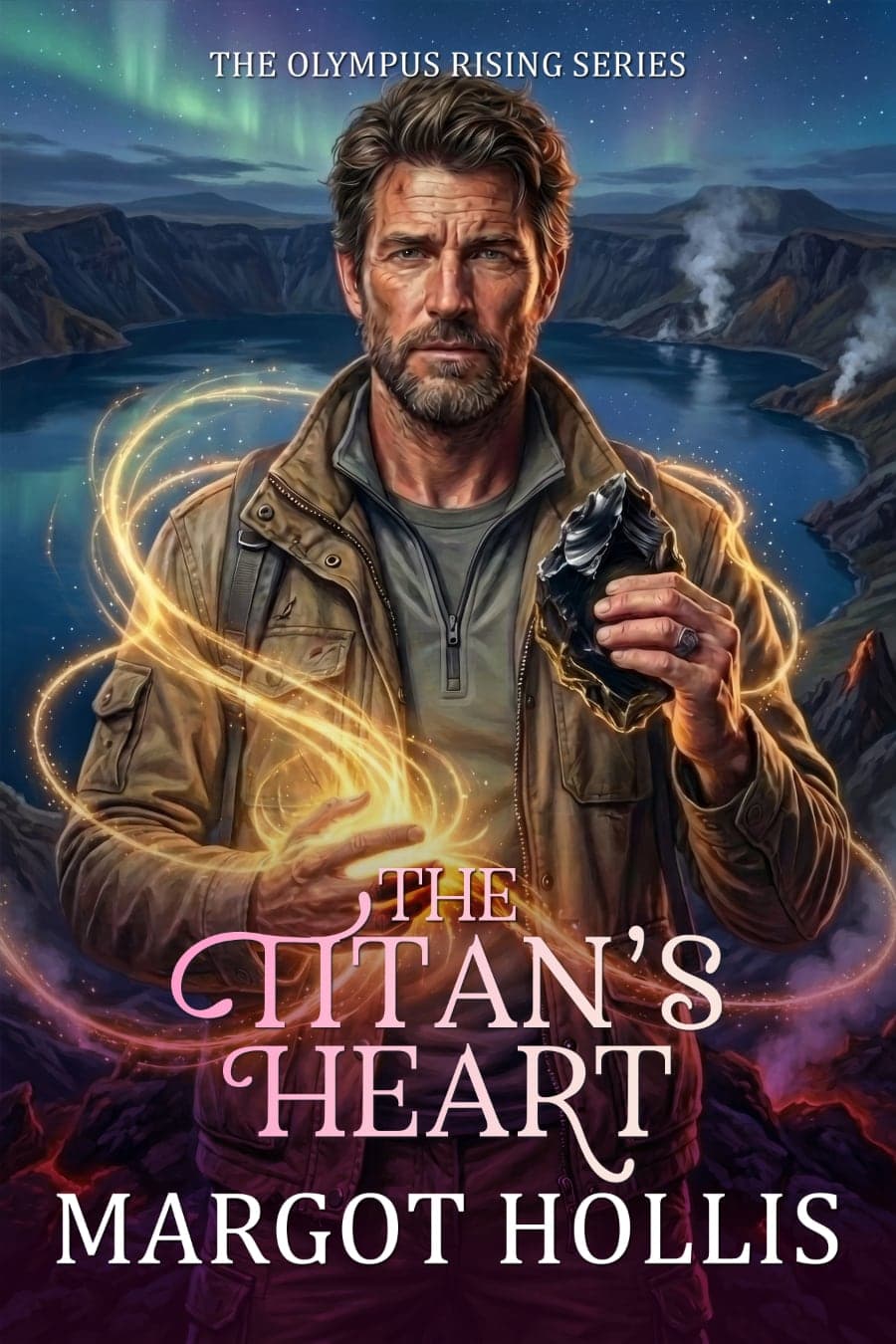
My grumpy New Zealand guide just turned out to be the God of War. And he’s been lying to me since the moment I hired him.
Lukas Helms treated my PhD like fancy paperwork and my equipment like expensive junk. Every word from him was clipped, dismissive, professional. I told myself I didn’t care. I told myself the way he looked at me—like I was something fragile he desperately wanted to protect—meant nothing.
Then my Resonance Imager detected a heartbeat beneath the volcano.
A portal tore the sky open. Gods walked through. And Lukas, who’d been hiding in these mountains for 150 years, was forced to reveal exactly what he is.
Now his sons are hunting us. Cultists are closing in. And the weapon I accidentally woke—the Titan’s Heart—is calling every power-hungry monster in the mythological world to our doorstep.
Lukas swears he’ll protect me. But if his enemies reach us first, protecting me might mean becoming the very thing he’s spent centuries trying to bury.
