
The Titan’s Heart – Chapter 1
Sonja
The sign is the first red flag. Carved into a thick slab of what looks like native rimu wood, the words “Helms Deep Adventures” are etched in a font that tries too hard to be epic. It is objectively ridiculous, a blatant appeal to a specific brand of fantasy-loving tourist. If I had any other option, I would turn around right then. But I don’t. My grant application for the Tongariro traverse has been approved based on a single, non-negotiable condition: I have to use a local guide service with a flawless safety record for alpine crossings in extreme weather.
There is only one.
I push open the heavy wooden door, a small bell chiming overhead. The air inside is cool and smells of oiled leather, canvas, and damp soil after a rainstorm. It is the scent of a world completely alien to my climate-controlled labs and university archives. The space is a study in organized chaos. Coils of brightly colored rope hang from pegs on the wall, alongside ice axes, crampons, and harnesses that look more like instruments of torture than safety equipment. Maps of the central plateau, creased and marked with spidery ink, are pinned over every available surface. This isn’t a rental shop for weekend warriors. This is a professional outpost.
A man sits behind a massive desk made from the same dark wood as the sign, his head bent over a whetstone and a large, serious-looking knife. He doesn’t look up. The rhythmic scrape of steel against stone is the only sound in the room. I clear my throat.
Nothing.
“Excuse me,” I try, my voice louder than I intend.
The scraping stops. He lifts his head slowly, and my carefully prepared speech dissolves into a jumble of useless data points. The website has a photo, of course, but it is a low-resolution, sun-bleached image of a man in sunglasses and a hat. It hasn’t done him justice.
Or perhaps it has done him a disservice.
His eyes are the color of a storm gathering over a granite peak, a turbulent, slate gray that seems to assess, categorize, and dismiss me in a single, unblinking glance. He is probably in his mid thirties, with short, dark hair that looks like it is cut with the knife he is holding. A faint network of silver scars webs across his tanned forearms, disappearing under the sleeves of a henley that strains across a chest and shoulders built for hauling much heavier things than scientific equipment. He isn’t just in shape; he is honed, carved from something harder than the surrounding mountains. A coiled, quiet energy emanates from him, the kind of stillness that precedes a violent act.
“We’re closed,” he says. His voice is a low rumble, like distant rockfall.
“Your website says you take appointments,” I say, forcing my feet to carry me closer to the desk. I place my hands on its polished surface, grounding myself. I am Dr. Sonja Reed. I have three peer-reviewed publications and a doctoral thesis on plate boundary volcanism. I am not intimidated by a man who looks like he wrestles bears for sport.
He sets the knife and stone down with meticulous care, the click of metal on wood echoing in the silence. His gaze drops to my hands, then travels up my arms, over my practical (and expensive) all-weather jacket, to my face. I feel like a specimen under a microscope.
“I need to hire a guide.”
“We’re fully booked for the season.”
“I was told you were the only guide certified for off-trail expeditions into the Te Maari craters.”
A flicker of something—annoyance, maybe—passes through his stormy eyes. “Who told you that?”
“The Department of Conservation.” I slide a laminated map across the desk toward him. It is a topographical survey of the volcanic plateau, the area of my proposed research cross-hatched in red. “My project requires placing a series of wide-band seismic sensors along this specific transect. It’s a two-week expedition.”
He doesn’t even glance at the map. His focus remains entirely on me. “You look like you’d be more comfortable at a café in Auckland.”
My jaw tightens. “And you look like you should be modeling for a lumberjack calendar. Does that have any bearing on our respective professional competencies?”
The corner of his mouth twitches, a barely perceptible motion. It might be a smile, or it might be a grimace. “Maybe. The mountain doesn’t care about your PhD. It cares about whether you can carry a thirty-kilo pack for ten hours and still have the sense to find shelter when a southerly hits.” He finally looks at my map, his finger tracing the red line of my proposed route. “This is a bad line. The north face of that ridge is unstable. Loose scoria. You’ll waste half a day for every hundred meters you gain.”
“My sensor placement is dictated by the subsurface geology,” I counter, my frustration mounting. “I need to align them with the magma-caldera fault line. It’s not arbitrary.”
“Everything up there is arbitrary,” he says, pushing the map back toward me. “The ground you think is solid could be a steam vent tomorrow. The path you plan on a map is just a suggestion. The mountain decides where you go.”
“Which is why I need you,” I say, forcing the words through gritted teeth. “I am a scientist. I am not an alpine guide. But I’m also not an idiot. I’m fit, I have the best gear money can buy, and I follow instructions.”
He leans back in his chair, the wood groaning in protest. He crosses his powerful arms over his chest and subjects me to another long, silent appraisal. I stand my ground, refusing to fidget, refusing to let him see the professional desperation churning in my gut. After my funding for the Kamchatka project fell through, this expedition is my only chance to salvage my career. A rival academic had published a paper that essentially torpedoed my primary thesis, and I need new, groundbreaking data to fight back. This trip isn’t just a research project; it is a lifeline.
“What’s your field experience?” he asks.
“I’ve done survey work in the Sierra Nevada and the Cascades,” I say. It sounds more impressive than it is. Those had been summer expeditions on well-marked trails with a full support team.
“Not the same,” he states. “There’s nothing here to stop the wind between you and Antarctica. The weather can change from sun to a blizzard in twenty minutes. You get lost, you get hurt… no one is coming for you.”
“I am aware of the risks.”
“Awareness and experience are two different things.” He stands up, and I have to crane my neck to maintain eye contact. He’s taller than I’d thought, well over six feet, and radiates an intimidating aura of pure physical capability. He walks around the desk, stops in front of a rack of gear, and picks up a pack, a monstrous thing that looks like it could hold a small car. “You carry your own gear. All of it. Plus your share of the food and team safety equipment.” He gestures to my own expensive but comparatively modest pack, which I’ve left by the door. “That won’t cut it. You’ll use one of ours.”
I open my mouth to argue about my carefully calibrated weight distribution, then shut it.
“My word is law,” he continues, his voice leaving no room for negotiation. “I say we turn back, we turn back. I say we don’t cross a ridge, we don’t cross it. I don’t care about your sensors or your fault lines. My only job is to get you back down in one piece. Your science is a distant second. If you can’t accept that, find another guide.”
The finality in his tone is absolute. This is my one shot.
I have to make it work.
“Fine,” I say, my voice tight. “Your terms are… acceptable.”
He nods once, a sharp, decisive motion. “My fee is five thousand a week. Paid in full. Up front.”
I blink. The figure is astronomical, nearly double the going rate and well over the budget I’d allocated. “That’s…”
“Non-negotiable,” he finishes for me. He walks back behind his desk and pulls a form from a drawer. “Fill this out. Emergency contacts, medical history, next of kin.” He slides it across the desk along with a pen. “I’m Lukas Helms.”
“Dr. Sonja Reed,” I clip out, taking the form.
He gives me a look that is almost pitying. “Up there,” he says, gesturing vaguely toward the window and the distant, jagged peaks, “you’re just Sonja.”
I spend the next ten minutes filling out the form, my hand moving with stiff, angry motions. Ugh. He’s sooooo arrogant, overbearing, and extortionately expensive. But as he’s pointed out the flaw in my proposed route, I’ve seen a flash of something else: an absolute, instinctual understanding of the terrain that no map could ever provide. He doesn’t just work in these mountains; he’s a part of them. And he’s right. I need him.
I fill in my emergency contact—my department head at Stanford, a man I haven’t spoken to in six months—and list my only known allergy to penicillin. When I finish, I push the form and my credit card across the desk.
He takes the card, his rough fingers brushing against mine. Whoa. I pull my hand back as if burned. His expression doesn’t change, but I could have sworn I saw his gray eyes darken for a fraction of a second. He processes the payment on a small, battered terminal, the beeps sounding unnaturally loud in the tense silence.
“We leave at dawn tomorrow,” he says, handing my card back. “Be here at 0500. Not 0501. I’ll have your pack and supplies ready.”
“I’ll be here,” I say, my jaw still tight.
I stand and turn to leave, my pride smarting from the negotiation. I have won, technically. I have my guide. But it feels like a complete capitulation. I’m a respected scientist, used to being in charge of my own research, my own expeditions. For the next two weeks, I’ll be little more than a piece of cargo he’s responsible for.
I am halfway to the door when his voice stops me.
“Sonja.”
I turn. He’s holding up the knife from before, its edge now gleaming with a lethal sharpness.
“You said you had the best gear,” he says, his gaze dropping to the hiking boots I wear. “Those are fine for a day hike. But the soles are too flexible. They’ll be shredded on the volcanic rock in three days, and you’ll have blisters the size of eggs. Get a pair of proper alpine climbing boots. Stiff shank. Full tang.”
My cheeks flush with heat. Of course. I debated about the boots, opting for a lighter, more comfortable pair against my better judgment. For him to spot the weakness in my preparation so quickly, so casually, is infuriating.
“I’ll take that under advisement,” I manage to say.
He gives a short, humorless laugh. “It’s not advice.”
I don’t dignify that with a response. I walk out of the shop, the little bell chiming my exit. The bright Queenstown sun feels jarring after the dim, masculine cave of his office. I stand on the pavement, taking a deep breath of the clean air, my chin shaking with fury.
Lukas Helms is a throwback. A relic from an era before GPS and satellite phones, a man who trusts muscle and instinct over data and planning. But as the image of his intense, stormy eyes and the sheer, quiet confidence of his presence replays in my mind, a different feeling mingles with the irritation.
He isn’t just a guide. He’s a predator, and I have just paid him an obscene amount of money to lead me directly into his territory. I have a sudden, sinking feeling that I’ve just made the most illogical, unpredictable, and monumentally reckless decision of my life.
Here we go.
You have been reading The Titan's Heart...
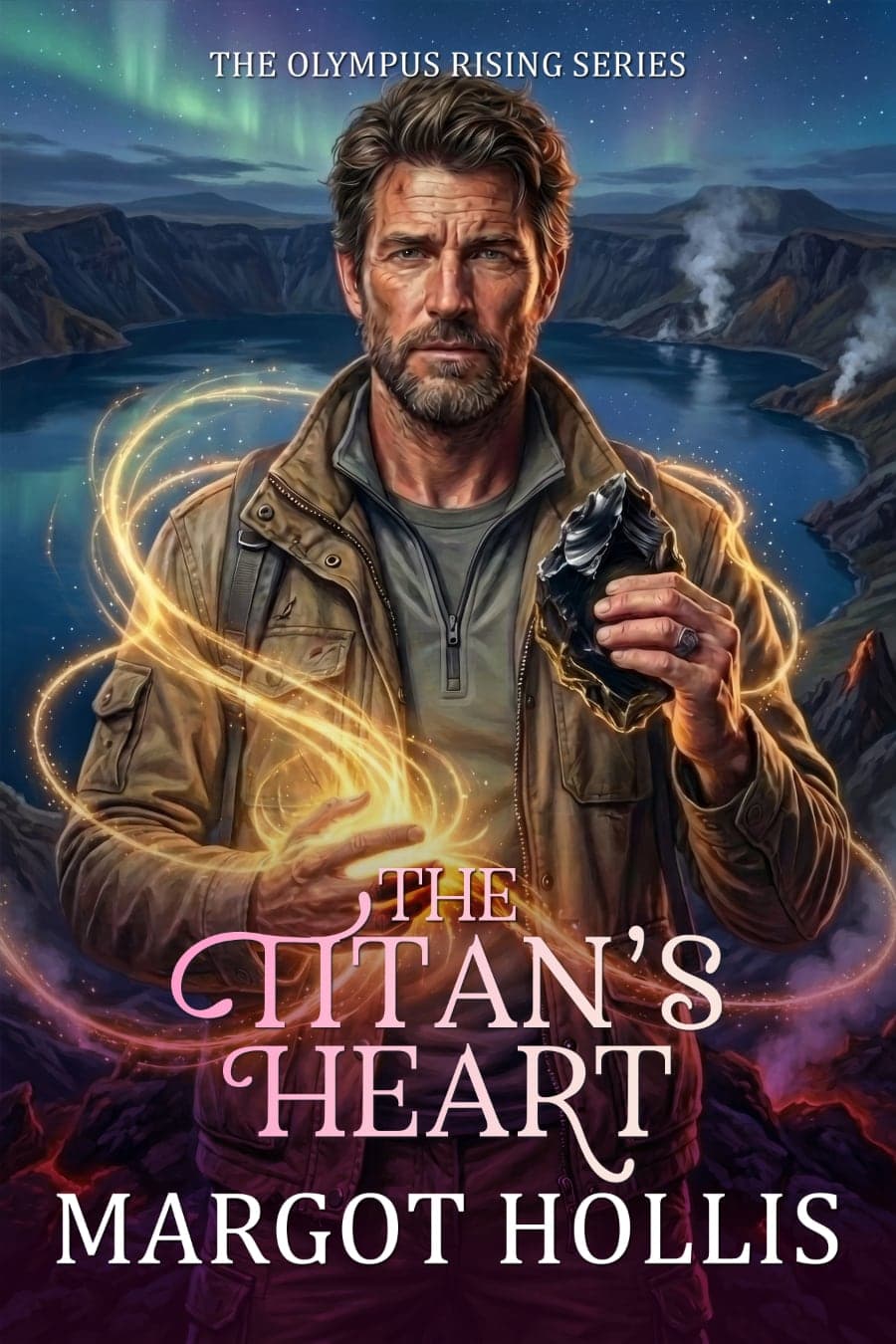
My grumpy New Zealand guide just turned out to be the God of War. And he’s been lying to me since the moment I hired him.
Lukas Helms treated my PhD like fancy paperwork and my equipment like expensive junk. Every word from him was clipped, dismissive, professional. I told myself I didn’t care. I told myself the way he looked at me—like I was something fragile he desperately wanted to protect—meant nothing.
Then my Resonance Imager detected a heartbeat beneath the volcano.
A portal tore the sky open. Gods walked through. And Lukas, who’d been hiding in these mountains for 150 years, was forced to reveal exactly what he is.
Now his sons are hunting us. Cultists are closing in. And the weapon I accidentally woke—the Titan’s Heart—is calling every power-hungry monster in the mythological world to our doorstep.
Lukas swears he’ll protect me. But if his enemies reach us first, protecting me might mean becoming the very thing he’s spent centuries trying to bury.
