Seasons of Writing with AI – Chapter 1
Part 1: Spring – Awakening Creativity
“The artist is a receptacle for emotions that come from all over the place: from the sky, from the earth, from a scrap of paper, from a passing shape, from a spider’s web.” — Pablo Picasso
First Steps with AI
You’ve heard the buzz. You’ve seen the headlines. Maybe you’ve even watched a few YouTube videos about it. Artificial intelligence is changing the way authors write, and you’re curious.
Or perhaps you’re beyond curious—you’re eager but hesitant, excited but overwhelmed. Don’t worry. I’ve been there too, and so has every author who’s incorporated AI into their writing process.
If you picked up this book, chances are you’re somewhere on the path of figuring out how AI fits into your writing world. Whether you’re just dipping your toes in or you’ve been dabbling for a while, this chapter will help you get your bearings as we begin our seasonal journey together.
Beginning the Journey
When I first started working with AI for writing back in 2021/2022, it felt like standing at the edge of uncharted territory with nothing but a vague map and a sense of adventure. The earliest versions of AI have only been commercially available since 2020. ChatGPT 4 and later versions of Claude have only been available for a little over a year.
Even for those of us who started writing with AI in the early days, this is still very new.
If you’re reading this right now, congratulations! You’re an early adopter!
So we have to take the mindset of an early adopter. This means we need to experiment, try new ideas, and work together to share what we learn. There is no beaten path or process to follow yet because everything is changing so quickly.
Mindset Shift: This. Is. An. Exciting. Time.
So let’s start blazing some trails.
Just like you didn’t learn to write overnight, you can’t learn to use this new tool overnight either.
A few years ago, many writers tried to switch to dictation to improve their workflow. While Dragon dictation can be set up in a few hours, it took some people weeks or even months for dictation to really click over using a keyboard.
Where Are You Now?
Before we go too far, it’s worth taking a moment to consider where you currently are in your AI writing journey. When I survey authors about their AI skills, they consistently underrate themselves and their knowledge. Let me share a simple framework that might help you gauge your current level:
Beginner: You’ve created an account with ChatGPT or Claude, but you’re not sure how to get consistent results. You’ve tried asking it to write something, but the output feels generic or doesn’t match your voice or genre expectations.
Intermediate: You understand how to craft better prompts and can get good results for specific tasks like brainstorming or planning. You’ve developed some repeatable processes but still struggle with longer-form content or maintaining consistency across chapters.
Advanced: You have systems in place for different writing tasks and can predictably generate quality content. You understand how to layer prompts, create writing briefs, and edit with AI. You may be experimenting with fine-tuning models or creating custom systems.
Wherever you are on this spectrum, remember that it’s just a snapshot of a moment in time. The goal isn’t to race to “advanced” status—it’s to find the ways AI can best serve your unique writing process.
Overcoming Initial Hesitation
One of the biggest hurdles for many authors is the initial resistance to incorporating AI into their creative process. I’ve heard all the concerns:
“Won’t it make my writing sound generic?” “Can I trust it with my ideas?” “Will it replace my creative voice?” “Is this even real writing anymore?”
These are valid questions. Important questions, even. And I’d be concerned if you didn’t have some hesitation about introducing a new technology into something as personal as your writing process.
But here’s what I’ve discovered after working with hundreds of authors through the Future Fiction Academy: AI doesn’t replace your creativity—it amplifies it. It doesn’t steal your voice—it can help you find it. And it won’t make your writing process obsolete—it will transform it into something potentially more fulfilling.
The key is understanding that you remain the author. The AI is a tool, not a replacement. A collaborator, not a competitor.
Setting Realistic Expectations
“AI is a tool where you will see the greatest gains if you apply it where you are weakest.”
This insight has been one of the most powerful realizations for authors I’ve worked with. Let me explain what I mean.
“You cannot be anything you want to be, but you can be a whole lot more of who you already are,” as Curt Liesveld of Gallup said.
AI is a tool where you will see the greatest gains if you apply it where you are weakest. If you are really good at character development and arcs, AI won’t make you much faster or improve your quality (you’re already rocking your characters!).
However, if you struggle with outlining and plot twists and spend days struggling to come up with ideas, AI can eliminate all that time and effort!
So the very first step you need to take to figure out how AI will fit into your workflow is to find where you need help.
Yes, yes, we understand. This seems obvious.
But after working with hundreds of students at the FFA, we find that many writers skip this step. Take a hard look at your writing process. Really look at the parts that take the longest, that you dislike, struggle with, or are dissatisfied with the results. Those are the places you want to add AI.
Start Simple, Be Explicit
When many people start working with AI, they get excited and try to incorporate it into every part of their writing process. Don’t get me wrong – we LOVE playing with AI and trying it out in every way we can. And we welcome everyone to join us down the rabbit hole that is AI.
After coming back up for air and light, though, many writers are frustrated that writing with AI, and all its promises of productivity and automation, actually took longer than writing without AI.
How can that be?
The answer is often that they tried to do too much too soon. They asked the AI to “write a romance novel” instead of breaking that request down into manageable pieces—character development, scene planning, dialogue creation, and so on.
Start at the same place you would in your non-AI writing process, but you’ll often have to be slower and more explicit with an AI. Where a human would assume that when you create a character it should have a name, you might have to directly ask the AI for this piece of information with clear, concise, and direct instructions.
When you’re first starting to work with AI, it’s best to start with a smaller work, such as a short story or novella, to get a feel for the process. Then, walk through all the elements you’ll need to build the story.
The key is to find a systematic process. One that creates and then gives the AI all the components it needs to construct and write a story.
Your First AI Writing Exercise
Let’s end this chapter with a simple exercise to get you started. This will help you begin to develop a feel for how AI responds to your instructions and how you can collaborate effectively.
Try this: Ask the AI what it needs from you to write a short scene.
A simple prompt might be:
“I want to write a short scene for a novel. What information would you need from me to help write this effectively?”
The AI will likely respond with a list of elements like character details, setting information, the conflict or purpose of the scene, tone, and so on. This response serves two valuable purposes:
- It gives you a roadmap of what information the AI finds helpful
- It starts training you to think systematically about your writing
Once you have this list, you can begin filling in details for a simple scene. Don’t worry about making it perfect—this is just practice. The goal is to start developing a feel for the back-and-forth collaboration that makes AI writing effective.
Looking Ahead
As we move from Spring into Summer in our seasonal journey, remember that these first steps are about exploration and discovery. You’re learning a new language—not just prompting, but a new way of thinking about your writing process.
In the chapters ahead, we’ll build on these foundations. We’ll explore more sophisticated prompting techniques, develop consistent workflows, and discover how to maintain your unique voice while leveraging AI’s capabilities.
But for now, celebrate taking these first steps. Every master was once a beginner, and the path you’re starting down has the potential to transform not just how you write, but how you experience the joy of creation itself.
So let’s begin.
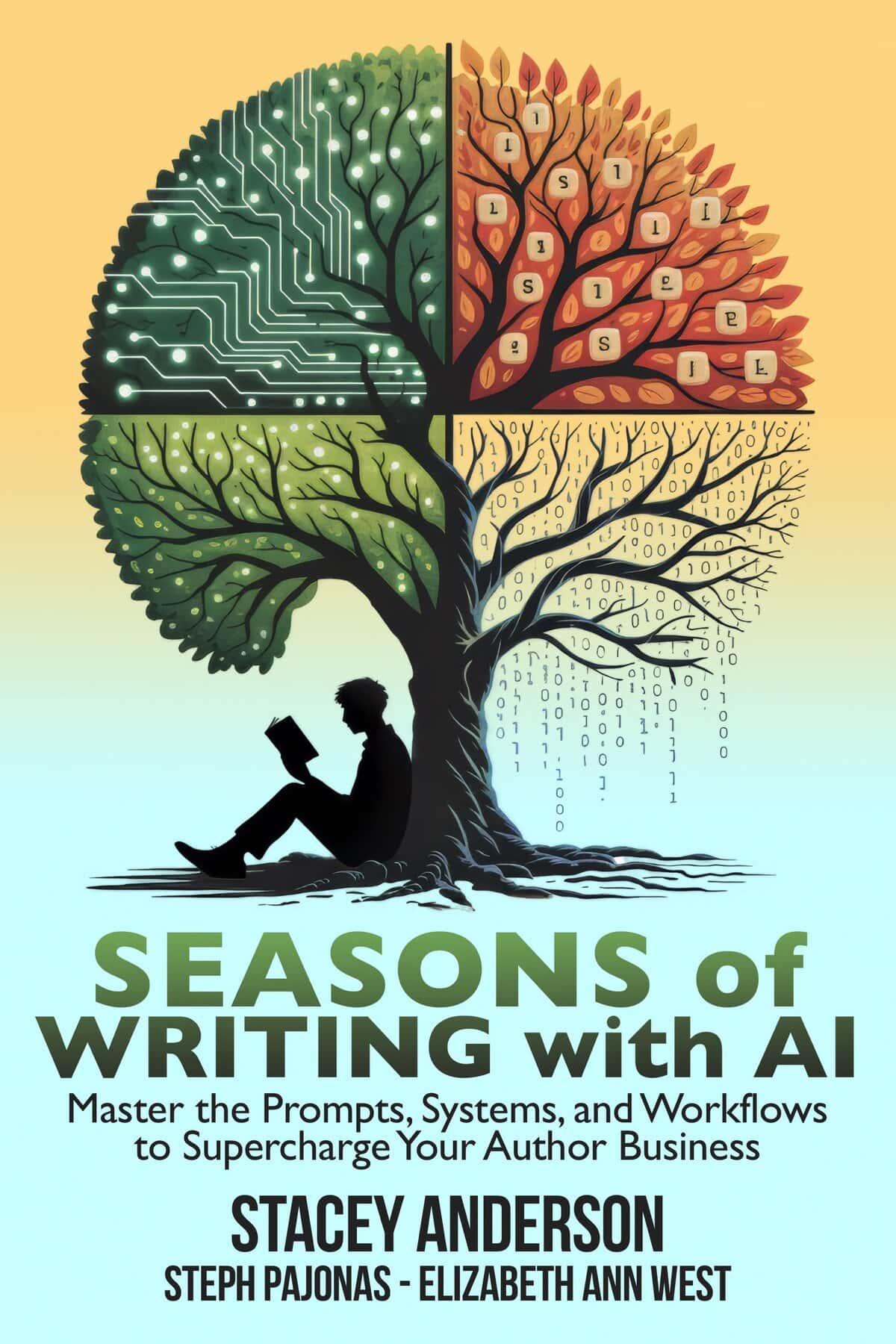
You have been reading Seasons of Writing with AI...
So, you’ve started using AI, but it’s not the magic bullet you hoped for.
The output is generic, the process is clunky, and you’re spending more time fixing text than writing it.
Sound familiar? You’re not alone.
Seasons of Writing with AI is your practical field guide to bridging the gap between AI’s promise and its reality. This isn’t another beginner’s guide or philosophical debate—it’s a collection of battle-tested strategies from 18 months of real-world use by publishing authors who are thriving with AI.
Inside, you’ll discover:
- Your Personal AI Style: Find out if you’re a Gardener, Weaver, Baker, or Architect, and build a workflow that actually works for you
- Advanced Prompting Systems: Master Writing Briefs and Megaprompts to generate consistent, high-quality prose with minimal editing
- How to Speak AI’s Language: Overcome frustrating miscommunications and get the specific results you want, every time
- Beyond the Manuscript: Transform your marketing, create stunning visuals, and even produce audiobooks
Stop wrestling with your AI and start a true creative partnership. Your journey from frustration to mastery begins here.
