
Fighting Love’s Flame – Chapter 3
The command post RV smelled like stale coffee and too many bodies crammed into too small a space. June blinked against the glare of computer monitors reflecting tactical maps—swaths of angry red spreading across Ridge 302 like a bloodstain.
Captain Lemar Lennon stood flanked by grim-faced crew bosses. His voice filled the cramped space, a low rumble that commanded instant silence. “Listen up. Ridge 302 blew past containment lines overnight. We’re shifting to Plan Bravo—hold the northern flank, sacrifice the southern gulch.”
A collective groan rippled through the room. June recognized the sound—not defeat, but the weary acceptance of seasoned professionals facing a brutal arithmetic. Save what you can. Lose the rest.
“Morrison” — Lennon’s gaze found Jake standing beside her — “your team holds the anchor point on the ridge crest. We lose that, we lose the valley.”
Jake gave a single sharp nod. His eyes were fixed on the map, tracking the fire’s projected path. June saw the way his thumb rubbed almost imperceptibly against his thigh—a tell she hadn’t noticed before.
Lennon turned, his gaze landing on June. “Now, embed protocol. Harrington, step forward.”
Every eye in the RV followed her. She felt the weight of their skepticism. These were people who lived and died by trust, and she was an unknown variable. A distraction.
“Rules are simple,” Lennon said, holding up a laminated card. “One: Full PPE at all times outside camp perimeter. That means helmet, goggles, face shield deployed near active flame. No exceptions.”
He handed her the card. Fire Shelter Deployment Protocol. Step-by-step illustrations showed a figure crouching inside a silvery cocoon.
“Two: You obey Morrison or his designated lead. No debate. If he says run, you run. If he says get down, you hit dirt. Understood?”
“Understood, Captain.” Her voice sounded steadier than she felt.
“Three: No filming during active suppression. Period.” Lennon held up a hand as Jake shifted beside her. “However.” He paused, meeting Jake’s glare without flinching. “Morrison will designate safe observation points during mop-up and staging. You’ll get your footage, Harrington. But only when he green-lights it.”
A compromise. June saw Jake’s knuckles whiten where they gripped the edge of the map table. He didn’t like it. She forced herself not to react, keeping her face neutral. “Thank you, Captain.”
Lennon’s gaze swept the room. “She documents the fight. We need the public to see what we’re up against. Forty percent cuts mean no jumpers next year. No air support. We lose this fight in the capital, we lose everything. Make her welcome. Dismissed.”
The meeting fractured into urgent side conversations. June caught snippets—fuel moisture levels, air tanker schedules, wind shifts. She turned to Jake, ready to acknowledge the compromise.
He was already walking away.
June hurried after him, catching up outside the RV where the afternoon sun filtered through thickening smoke. “Morrison.”
He didn’t slow. “Briefing’s over. Gear up. Wheels up in twenty.”
“I know about the filming compromise—”
“And I know Lennon’s playing politician.” Jake stopped, forcing her to skid to a halt. He turned, his eyes scanning her from helmet to boots in a quick, impersonal assessment. “Safe observation points during mop-up? That’s paperwork and ash. Not exactly prime-time drama.”
“It’s a start.” She held her ground. “And I’ll follow your rules on the line. But don’t pretend you’re the only one risking something here.”
He raised an eyebrow. “You think this is risky? Wait until the first ember shower hits your face shield. It changes the definition.” He started walking again, heading toward the supply tents. “You need a line pack. Water, fire shelter, basic med kit. Move.”
The supply line moved with practiced efficiency. June found herself handed a heavy backpack, a folded foil shelter that felt disturbingly flimsy, and a compact medical pouch. Jake watched as she clipped them onto her frame.
“Too loose,” he said, reaching out to adjust the sternum strap. His fingers brushed the base of her throat. She froze. He didn’t seem to notice, tightening the strap with clinical efficiency. “Carry weight high on your hips. Saves your back on long hikes.” He tapped the fire shelter pouch strapped to her thigh. “Practice deploying this tonight. In the dark. With gloves on.”
“Is that necessary?” June shifted under the weight of the pack. “I read the protocol—”
“Reading doesn’t save lives. Muscle memory does.” He picked up a pair of heavy leather gloves and shoved them at her. “Put these on. Now.”
The gloves were stiff and too large. June fumbled with the straps as Jake watched, arms crossed. His silence was worse than criticism. She finally secured them, flexing fingers that felt clumsy and slow.
“Good. Now take your shelter out.” He pointed to a patch of dusty ground near the supply tent. “Deploy it. Fast.”
June unclipped the pouch, fingers thick in the unfamiliar gloves. The thin foil felt slippery. She remembered the diagrams—pull the handle, crouch, crawl inside. Simple. But her hands shook as she gripped the ripcord.
“Go!” Jake barked.
She yanked. The shelter exploded outwards with surprising force, unfolding into a silver dome. She dropped to her knees, scrambling inside as instructed. The interior felt stifling, smelling of plastic and trapped heat. She pulled the edges down around her, sealing herself in darkness.
After a beat, Jake’s voice came muffled through the foil. “Forty-two seconds. Too slow. Embers burn through nylon in ten. Do it again.”
June crawled out, face flushed. She repacked the shelter with trembling hands, aware of curious glances from passing crew members. Jake said nothing, just watched with detached focus. She ripped the cord again, dove inside.
Thirty-eight seconds. He made her do it six more times until she hit twenty seconds consistently. Her knees were scraped raw through the Nomex, her breath coming in quick gasps.
“Better,” he said as she emerged, sweat trickling down her temple. “Do it ten times tonight. After dark.” He turned toward the helipad. “Move out.”
The flight to the ridge was a nightmare of noise and vibration. June clutched her pack, staring out at the approaching wall of smoke.
Jake sat opposite her, checking equipment with methodical precision—testing radio channels, inspecting the blade of his Pulaski axe, adjusting his helmet straps. He didn’t look at her. Didn’t speak.
His team operated with seamless, silent coordination. Tank Palmer caught her eye and gave her a thumbs-up, his grin a flash of white in a soot-streaked face. She tried to return it, but her lips were stiff.
The drop zone was a nightmare landscape. Charred stumps jutted like broken teeth from ash-covered earth. Smoke hung thick in the air, reducing visibility to mere yards. The heat was physical pressure against her skin, even inside the protective suit. Jake’s team hit the ground running, fanning out to establish a new anchor point.
“Harrington!” Jake pointed to a rocky outcrop overlooking the fire line. “Observation post. Stay there. Don’t move. Don’t touch your camera.”
June scrambled up the incline. The vantage point offered a terrifying panorama. Below, the fire raged through the treetops—a living thing, consuming everything in its path.
Jake’s team worked the edge, cutting line with chainsaws and Pulaskis, their figures dwarfed by the inferno. The roar was deafening, a constant, hungry growl punctuated by sharp cracks as trees succumbed.
She saw Jake moving along the line, checking each crew member, adjusting their positions with hand signals. Even from this distance, she could see the controlled precision in every gesture. He paused near Tank, pointing toward a snag—a dead tree engulfed in flames. Tank nodded, pulling charges from his pack.
June’s fingers itched for her camera. This was the story—the split-second decisions, the choreographed chaos of professionals dancing with death. But Jake’s words echoed. Lens cap on.
The controlled explosion dropped the snag away from their line. Jake’s team cheered, a brief burst of triumph before returning to work. June watched him move to the next position, the next problem. Always watching. Always calculating.
Hours blurred together in smoke and sweat. June’s water ran low despite careful rationing. Her shoulders ached from the pack weight. But she stayed at her post, watching Jake’s team hold the line against impossible odds.
As dusk approached, the fire behavior shifted. The flames laid down, exhausted by their own fury. Jake appeared at the base of her outcrop, his face mask pushed up, revealing features carved from exhaustion.
“Mop-up phase,” he called up. “You can film now. But stay with me.”
June scrambled down, stumbling on loose rocks. Jake caught her elbow, steadying her with surprising gentleness. “Easy. Fatigue makes you clumsy.”
She pulled out her camera with shaking hands. The familiar weight grounded her. Through the viewfinder, the devastation took on an eerie quality—not just destruction, but the aftermath of battle. Jake’s team moved through the blackened landscape, extinguishing hot spots, their headlamps cutting through gathering darkness.
“Tell me what you’re doing,” June said, focusing on Jake as he knelt beside a smoking stump.
He glanced at the camera, then away. “Checking for underground burn. Roots can smolder for days, reignite when wind picks up.” He dug with his Pulaski, exposing glowing embers. A spray from his drip torch extinguished them. “Miss one, lose the whole line.”
His voice was distinct on camera—professional, educational. The hostility had faded into bone-deep weariness. June tracked him as he worked, capturing the methodical attention to detail that revealed more about him than any interview could.
“Morrison!” Rodriguez called from the ridge. “Got a spot up here. Looks deep.”
Jake rose and June followed, camera rolling. They found Rodriguez and Thompson digging around a massive root system, orange coals glowing in the depths.
“Too hot for water,” Jake assessed. “Tank, bring the foam.”
June filmed as they worked—a careful application of fire-suppressing foam, Jake monitoring the temperature with an infrared gun. His team moved around him like extensions of his will, anticipating needs before he voiced them.
“How do you know what to prioritize?” June asked, surprising herself with the question.
Jake paused, wiping soot from his forehead. For a moment, she thought he wouldn’t answer.
“Experience. You learn to read fire like weather. Where it wants to go. What it needs to survive.” His eyes met hers through the camera lens. “Sometimes you’re wrong. Sometimes it takes everything anyway.”
The raw honesty in his voice made her lower the camera. They stared at each other in the smoky twilight, the question from earlier hanging between them. Have you ever seen someone burn?
“Morrison, we’re clear down here,” Tank’s voice crackled over the radio, breaking the moment.
Jake keyed his mic. “Copy. Start packing up. Evac in thirty.”
The flight back to base camp was quick. June reviewed footage on her camera’s small screen, aware of Jake watching from his seat across the aisle. She’d captured excellent material—his team’s competence, the scale of the threat, the exhausting reality of the work. But not the heart of it. Not yet.
They landed as full dark settled over camp. Jake’s team dispersed toward showers and food. June followed Jake toward their shared tent, her body screaming for rest.
“Practice the shelter deployment,” Jake said as they reached the tent. “Ten times.”
“Now?” June couldn’t hide her exhaustion. “It’s been fourteen hours—”
“Fire doesn’t care if you’re tired.” He unzipped the tent flap. “Ten times. Count them out loud so I know you’re doing it.”
June watched him disappear inside. Through the canvas, she heard him moving—the clink of medical supplies being checked, the rustle of him changing clothes. She dropped her pack and unclipped the shelter with aching fingers.
“One,” she called out, pulling the ripcord. The shelter deployed in nineteen seconds. Better. She repacked it, muscles protesting.
“Two.” Twenty-one seconds. Her headlamp beam wavered as exhaustion made her hands shake.
By the fifth deployment, her movements had smoothed into something approaching automatic. By the eighth, she’d stopped thinking about the steps.
“Ten,” she finally called, collapsing the shelter for the last time. Seventeen seconds. A personal record.
She stumbled into the tent to find Jake sitting on his cot, updating a medical log by lantern light. He’d changed into a clean t-shirt and cargo pants. He looked up as she entered, his expression unreadable.
“Good,” he said. “Shower tent’s three down on the left. Hot water’s usually gone by now, but the cold helps with the smoke smell.”
June grabbed her toiletry bag, too tired to respond. But as she reached the tent flap, his voice stopped her.
“That question. Earlier. About seeing someone burn.” He didn’t look up from his log. “Were you answering as a reporter, or…”
“No.” The word came out rough. “Not as a reporter.”
He nodded, still focused on his paperwork. “Shower. Eat something. Long day tomorrow.”
June escaped into the darkness, his unfinished question following her. The shower was indeed cold, shocking her system into alertness. She stood under the spray until her teeth chattered, washing away soot and sweat and the lingering smell of smoke.
When she returned to the tent, Jake was already in his sleeping bag, turned toward the wall. A small LED lantern glowed on her side, illuminating her cot. He’d left a protein bar and a bottle of water on her pillow.
June changed into sleep clothes, hyperaware of the thin space between their cots. The tent felt small in the darkness, filled with the sound of his breathing and the distant rumble of generators. She lay down, pulling the sleeping bag up to her chin.
“Thank you,” she whispered. “For the water.”
A long pause. “We look out for each other out here. Even the liabilities.”
It should have stung. Instead, she heard what he didn’t say—that she was part of the team now. She closed her eyes, exhaustion pulling her under.
But sleep wouldn’t come. The events of the day replayed behind her eyelids—the wall of flame, Jake’s sure movements, that moment of connection over shared trauma. Her camera bag sat beside her cot, within arm’s reach.
Carefully, she reached for it. The camera powered on with the faintest whisper. She’d turned off all the indicator lights earlier—a documentarian’s trick for unobtrusive filming. In the darkness, she could make out Jake’s form through the viewfinder.
She hit record.
His breathing was deep and even, the sleep of someone used to catching rest in tough places. The infrared setting revealed details invisible to the naked eye—the way his hand curled near his face, fingers twitching as if grasping for something. The furrow between his brows that didn’t smooth even in sleep.
This was the story. Not the heroics or the flames, but the human cost. The weight carried even in dreams.
A minute of footage. Maybe two. Then she’d—
“Turn it off.”
June’s heart jumped into her throat. Jake hadn’t moved, hadn’t opened his eyes. But his voice was awake, cold as mountain water.
“I said turn it off.”
With shaking fingers, she powered down the camera. The tent plunged back into darkness, broken only by the faint LED glow.
“I wasn’t—”
“You were.” He sat up in one fluid motion, a shadow against shadows. “First night, and you’re already breaking the rules.”
“You weren’t on the line. You were sleeping—”
“In my tent. My space.” His voice was quiet. “Tell me, Harrington. What kind of story requires footage of me sleeping? What angle are you working?”
The accusation stung because it was true. “I wanted to show the exhaustion. The toll this takes—”
“On me?” Jake swung his legs off the cot, bare feet hitting the tent floor with a soft thud. “You wanted to show me vulnerable. Weakened. Is that the story? Broken smokejumper can’t handle the pressure?”
“That’s not—” June clutched the camera to her chest, aware of their proximity in the small space. “I’m trying to show the human side of what you do.”
“The human side.” He laughed, a harsh sound devoid of humor. “You want human? Williams was twenty-two. First season jumping. Loved terrible jokes and his mom’s tamales. He died because someone hesitated. Because someone was thinking about how things looked instead of how they were.”
June’s throat constricted. “I know about making the wrong choice. About choosing the camera over—”
“Over what?” Jake leaned forward, his face emerging into the dim LED light. “What did you choose, Harrington?”
The words lodged in her throat. She saw it again—the earthquake aftermath, the collapsed school, the tiny hand reaching through rubble. Her camera rolling while she shouted for rescue crews that were blocks away. The hand going still before help arrived.
“A life,” she whispered. “I chose the shot over a life.”
The confession hung between them. Jake went still, his anger shifting into something else. Recognition, maybe. Or the particular exhaustion that came from carrying guilt like a chronic injury.
“When?” His voice had lost its edge.
“Three years ago. Ecuador.” June set the camera aside with trembling hands. “Magnitude 7.8. I was there covering the infrastructure recovery, but then the aftershock hit. This school…” She swallowed hard.
“I kept filming. Told myself the footage would help, would show people why aid mattered. But really, I was scared. Scared to put down the camera and try to help. Scared I’d make it worse.”
Jake was quiet for a long moment. When he spoke, his tone was neutral. “Did the footage help?”
“It raised two million in disaster relief.” Her voice trembled but held. “Everyone called it powerful journalism. Award-winning. But all I see is that hand going still while I hid behind my lens.”
“And now you’re here.”
“Now I’m here. I came to Whitewater Bay to just be June.” She pulled her knees to her chest, making herself smaller in the darkness. “Now I’m here at your base camp trying to prove I can document something without… without letting someone die for the shot.”
Jake shifted back onto his cot, the tension in his shoulders easing. “That’s why you agreed to my rules so easily. The no filming during operations.”
It wasn’t a question, but June nodded anyway. “I can’t trust myself. Not yet. Maybe not ever.”
“Trust isn’t binary,” Jake said after a pause. “It’s not something you have or don’t have. It’s something you build. One decision at a time.”
“Is that what your counselor says?”
A short laugh, almost surprised. “Among other things. Particularly fond of metaphors about controlling what you can control.”
“Does it help?”
“Some days.” He lay back down, the cot creaking under his weight. “Not others.”
June uncurled, her exhaustion returning in waves. “I’m sorry. About filming you. It was a violation.”
“Yes. It was.” But the heat had left his voice. “Don’t do it again.”
“I won’t.”
“And Harrington?”
“Yeah?”
“That hand going still—that wasn’t your fault. You were a journalist, not a rescue worker. Being there with a camera doesn’t make you responsible for every tragedy you witness.”
June’s eyes burned with unshed tears. “Doesn’t it?”
“No more than me being team lead makes me responsible for Williams choosing the wrong escape route.” The words came out raw, like they’d been torn from somewhere deep. “But we carry it anyway. Because someone should.”
The tent fell silent except for the distant sound of generators and the occasional pop of cooling metal from equipment outside. June lay in the dark, processing the strange intimacy of shared confession. Jake’s breathing hadn’t returned to sleep patterns—he was awake too, wrestling with his ghosts.
“Morrison?” she whispered.
A pause. “Yeah?”
“Thank you. For understanding.”
“Get some sleep, Harrington. 0500 comes early.”
June pulled her sleeping bag up. Through the thin canvas walls, she could hear the camp settling for the night—muted conversations, the clank of equipment being cleaned, someone’s radio playing country music two tents over.
“For what it’s worth,” Jake said into the darkness, “your footage today was good. The root system sequence—you caught why the work matters. Not the glory. The prevention.”
“You watched?”
“It’s my job to know everything happening with my team.” A pause. “You’re observant. You see patterns. That’s useful.”
It was the closest thing to a compliment she’d gotten from him. June smiled into her pillow. “Useful. High praise from you, Morrison.”
“Don’t let it go to your head. You still deploy your shelter too slow.”
“Seventeen seconds on the last one.”
“Still too slow.” But she heard the slight softening in his tone. “Fifteen tomorrow or you do twenty reps.”
“Deal.”
The tent fell quiet again. June’s body finally relaxed, muscles unknotting one by one. Tomorrow would bring more fire, more challenges, more opportunities to prove herself. But for now, in this small canvas shelter with its antiseptic smell and its damaged occupants, she felt something she hadn’t expected.
The camera stayed dark. The story could wait.
You have been reading Fighting Love's Flame...
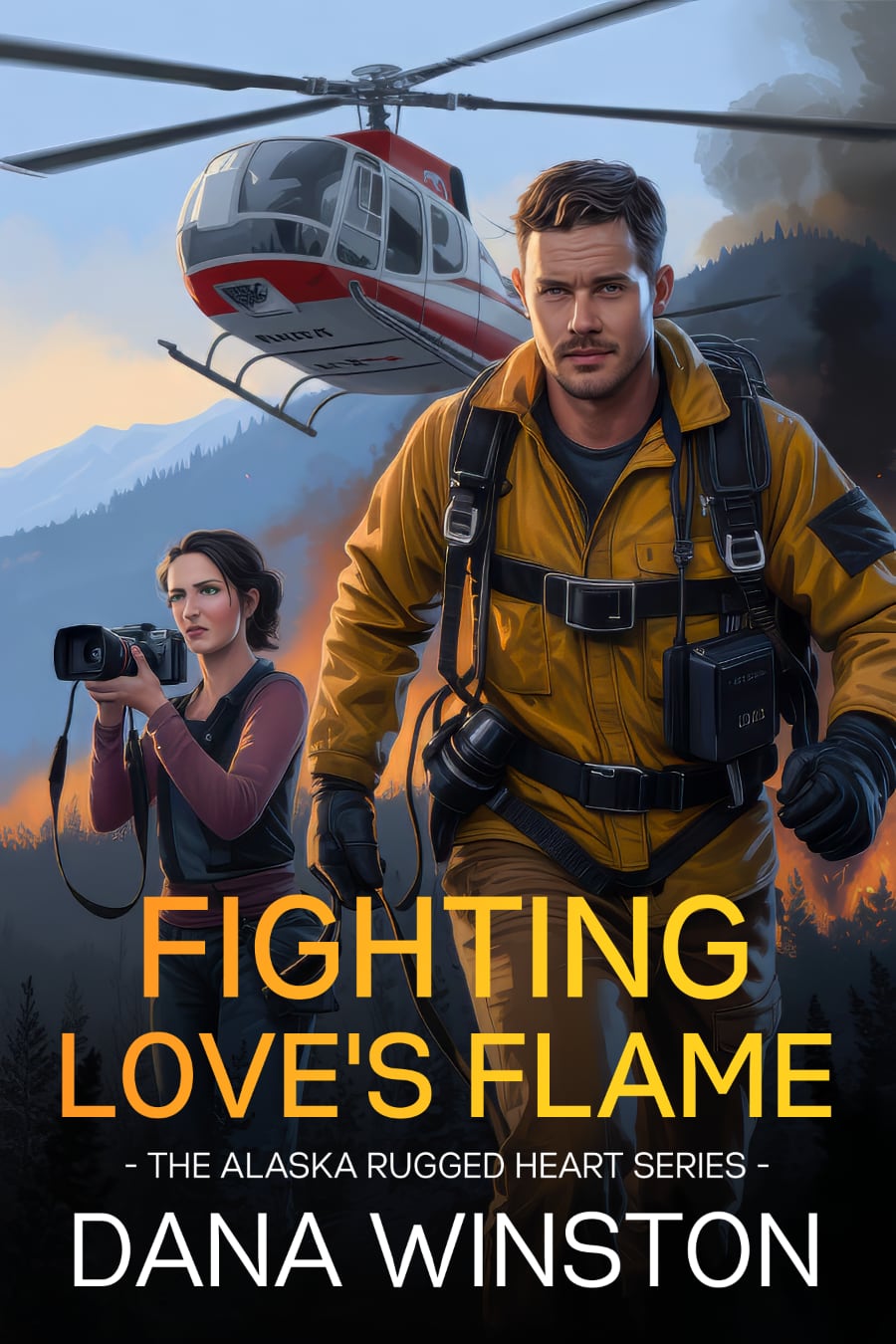
Sharing a tent with Alaska’s grumpiest smokejumper wasn’t part of June Harrington’s plan—but an overcrowded fire camp left her bunking with the one man who wanted her gone.
Jake Morrison made it clear from day one: her camera was a liability and his crew didn’t need a documentarian filming their every move. She made it equally clear she wasn’t leaving. Not when this assignment was her only shot at redemption for a past tragedy where she filmed instead of helping.
Every dangerous rescue revealed the devastatingly competent man beneath his stoic armor. Every quiet conversation exposed wounds that matched her own. He was drowning in guilt over losing someone under his command.
She understood that guilt better than anyone.
As they work together to save his program from budget cuts, the heat between them burns hotter than any wildfire—but when two people are convinced they don’t deserve second chances, can they risk trusting each other with their carefully guarded hearts?
Fighting Love’s Flame is a medical romance set in Alaska. It’s the third book in the Alaska Rugged Hearts Series and can be read as a standalone.
If you love workplace romance with forced proximity, grumpy smokejumper heroes finding redemption through love, and competent heroines who can save lives with a camera and melt hearts on the fire line—think Only the Brave meets Northern Exposure—then Fighting Love’s Flame is for you.
